
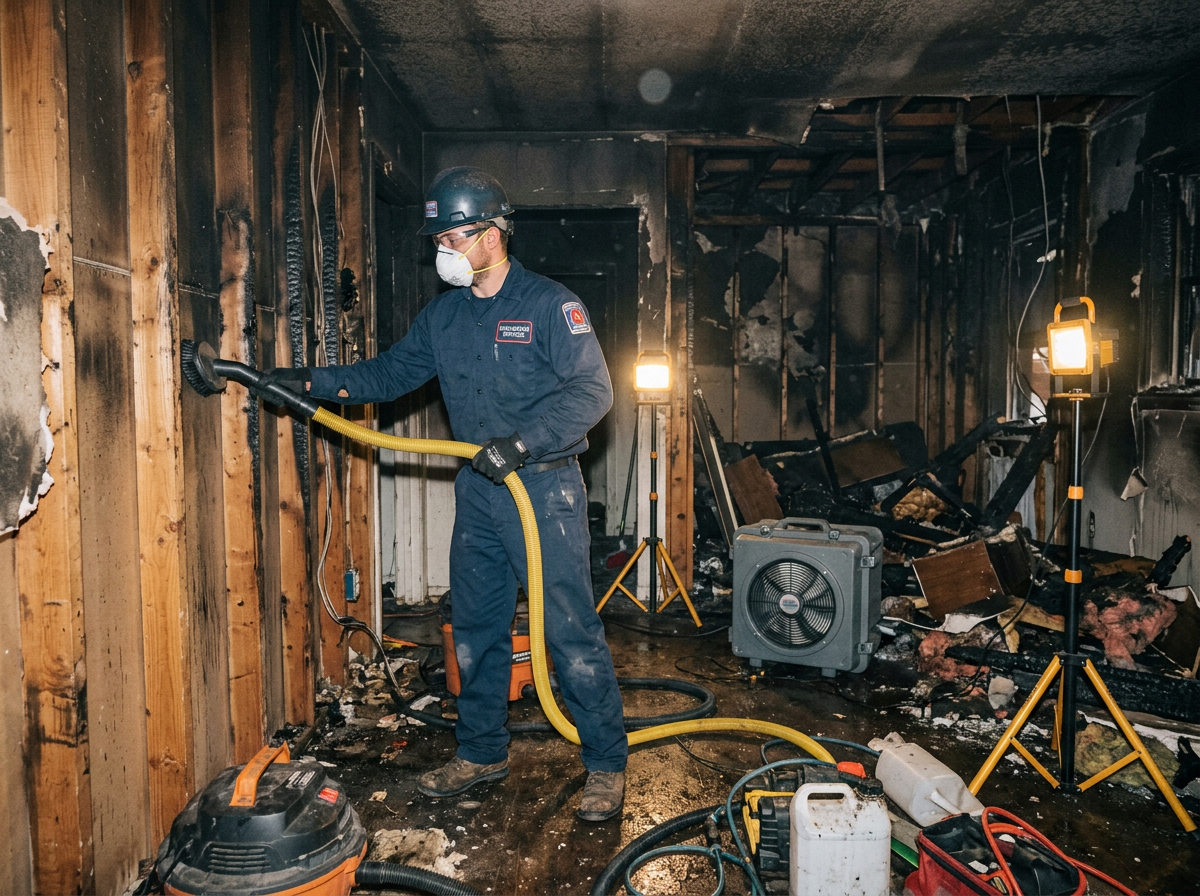
Oxford's post-war subdivisions sit on clay soils that hold meltwater against foundations, and many lower levels serve as finished living space rather than storage. Crews work from M-24 access points to extract water before it reaches drywall or electrical systems.
The same equipment and drying protocols apply whether the job is in Downtown Oxford or a neighborhood off M-24, with quick turnaround because the village layout keeps travel times short between homes.
Here's how our fire damage restoration work runs in Oxford — the same standards we hold across Michigan, delivered by the crew that covers Oakland.
Fire Damage Restoration Services We Offer in Oxford
✓Soot and Smoke Residue Cleaning
Removes acidic soot from surfaces and contents using specialized sponges and vacuums before it etches paint or fabrics in Ypsilanti homes.
✓Suppression Water Extraction
Extracts water introduced during firefighting from floors, walls, and basements while preventing cross-contamination with Category 3 sources.
✓Odour Treatment
Neutralizes embedded smoke odors through thermal fogging and air scrubbing rather than masking in older Michigan housing stock.
✓Board-Up and Tarping
Secures openings after fire with weather-resistant materials to protect against snow, rain, and further water intrusion common in Michigan winters.
Michigan homes near Ypsilanti often feature finished basements built over heavy clay soils and 42-inch frost lines, so when a structure fire occurs the water used to suppress it quickly saturates drywall, carpet padding, and insulation. Soot from burning plastics and wood travels through HVAC systems and settles on every surface, turning Category 1 suppression water into a corrosive mixture that etches metal and discolors porous materials within hours. Technicians must map moisture with meters before any wall closure because hidden saturation behind paneling leads to mold weeks later if missed.
Suppression water in winter fires frequently freezes inside wall cavities during January or February pipe-burst events that ignite from electrical shorts, requiring controlled thawing and repeated extraction passes. Finished basements with laundry standpipes and floor drains complicate cleanup because any standing water can backflow from combined sewers during the same storm that caused the outage. Odor treatment fails when crews skip thermal fogging or hydroxyl units on porous concrete floors that have absorbed smoke particles, leaving residual smells that return with humidity changes.
How It Works in Oxford
- 1
Initial Assessment and Safety
Inspect for structural compromise, identify soot types, and map moisture from suppression water before any work begins.
- 2
Containment and Extraction
Set up barriers and remove standing water plus loose debris to stop soot migration through HVAC and into finished areas.
- 3
Cleaning and Odour Neutralization
Clean surfaces and apply odour treatments suited to the smoke residue present in the specific fire event.
- 4
Drying Verification and Restoration
Monitor moisture levels until readings allow safe wall closure, then coordinate repairs with the homeowner.
Serving All of Oxford
We regularly handle fire damage restoration jobs near:
- 📍Oxford Village Park
- 📍Oxford Historic District
- 📍Downtown Oxford
- 📍M-24 corridor
Fire Damage Restoration Pricing in Oxford
Pricing follows inspection because soot type, water volume, and affected square footage change scope significantly; call for a direct assessment.
Want the full picture of this service? See our Fire Damage Restoration page, or everything we do in Oxford, MI.